LUXURY BATHROOM INTERIORS
THE GUIDE TO DESIGN YOUR IDEAL MODERN LUXURY RETREAT


The annual London Festival of Architecture (LFA) — a month-long, citywide celebration of architectural experimentation, thinking and practice — will take place at venues across the capital from 1—30th June, responding to this year’s theme of ‘Work in Progress’.
1. A Clockwork Jerusalem
Architectural Association
9 May—6 June
Weekdays 10am—7pm
Saturdays 10am—3pm
AA Gallery, 36 Bedford Square, WC1B 3ES

From Stonehenge to council estates, from Ebenezer Howard to Cliff Richard, from ruins and destruction to back-to-the-land rural fantasies, A Clockwork Jerusalem explores how the international influences of modernism became mixed with long standing British sensibilities. Through architecture, records, books and adverts, the exhibition examines how traditions of the romantic, sublime and pastoral, as well as interests in technology and science fiction, were absorbed to create a specifically British form of modernism.
A Clockwork Jerusalem focuses on British modernism at the moment it was at its most ambitious socially, politically and architecturally, but also on the point of collapse. A variety of large scale projects, images, objects and artefacts offer insights into the way architecture was central to manufacturing a new vision of society at a scale inconceivable today. The modern future of Britain was built from an unlikely combination of interests and these projects have changed our physical and imaginative landscapes.
Concept, Curation and Exhibition Design by FAT Architecture and Crimson Architectural Historians. Â Commissioned by the British Council for the British Pavilion, 14th International Architecture Exhibition, La Biennale di Venezia 2014.
2. Garden State
The Mosaic Rooms
14 May—20 June
11am—6pm
The Mosaic Rooms, 226 Cromwell Road, SW5 0SW

Coinciding with this year’s Chelsea Flower Show and London Festival of Architecture, we are pleased to present a free photography exhibition Garden State by Corinne Silva. Offering an unexpected view on gardening, the show comprises photographic and sound installations exploring Israel’s suburban gardens, parks and public places. Silva encourages visitors to view gardening not simply as the act of nurturing a plot of land, but as something potentially far more sinister: a tool used in aggressive state expansion, territory marking and occupation.
In this exhibition, Silva explores what gardening might represent in the context of Israel’s contemporary colonisation of Palestinian territories.
Garden State comprises two ambitious installations, created during a series of trips to sites between the Mediterranean Sea and the Jordan River from 2010 and 2013. Wounded (2013) is a series of nine photographs, taken shortly after a devastating fire in the Carmel Forest in Northern Israel, accompanied by sound recordings made by the artist as she pushed her way through the waist-high foliage that had grown in its place three years later. Only a small percentage of Israel’s forests are natural, when the Aleppo pine forest was first planted, other indigenous flora was pushed out. This immersive audio-visual installation presents the destruction of this national park as a reversal of the Israeli state’s re-creation and occupation of this landscape.
3. Japanese Temple Pavilion at Dorich House Museum
School of Architecture and Landscape, Faculty of Art, Design & Architecture, Kingston University
30 May—3 June
11am—4pm
Dorich House Museum, 67 Kingston Vale, SW15 3RN
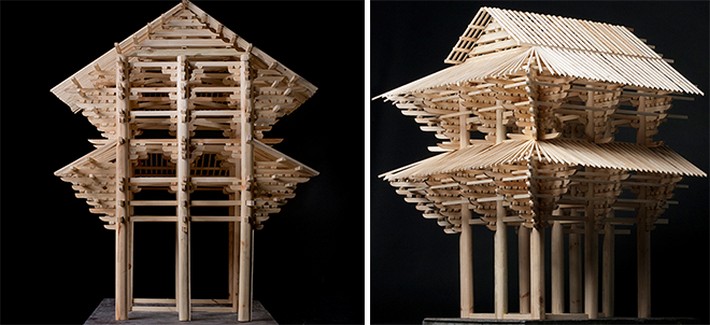
The architecture students from Studio 3.2 at Kingston University led by tutors Takeshi Hayatsu and Simon Jones will collaborate with the Faculty’s 3D Workshop and the Stanley Picker Gallery to install a wooden temple structure in the garden of Dorich House, Kingston Hill. Coinciding with an event called ‘History in Making’ at Dorich House in February 2015, this is the second occasion that the Studio will work with Stanley Picker Gallery to build temporary structures for local communities in the Kingston area.
The Studio has been building temporary wooden structures for the last three years with the Faculty’s 3D Workshops, as part of the on-going investigation into timber construction. All based upon historic timber structures from around the world, to date they have included, a footbridge from Kintaikyo, Iwakuni Japan, the spire formwork from Salisbury Cathedral, England, and the Woodland Cemetery Chapel, Stockholm Sweden. This year, the Studio will build an interpretation of the Temple Gate from Todaiji Nandaimon, Nara Japan.
4. Endo Shuhei: Paramodern Architecture 25/25
Endo Shuhei
24 June—14 July
9am—5pm (closed weekends)
TOTO Gallery, 140–142 St. John Street, EC1V 4UA
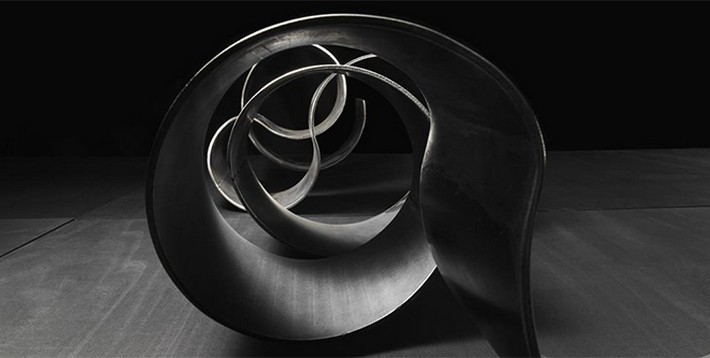
This touring exhibition showcases 25 architectural models from a selection of the Japanese Architect Shuhei Endo’s work. So far, the exhibition has been shown in Stuttgart, Milan and Paris. Shuhei Endo (b.1960) established his studio, the Endo Shuhei Architect Institute, in 1988. His work ranges from small residential projects , cultural centres and educational buildings to large-scale sport stadia and infrastructure. Endo’s work is economical yet imbued with restless energy and deeper levels of meaning. The architectural models displayed in this touring exhibition operate like a Zen riddle, each one poised to become something else once the riddle is solved. In the introductory essay of Endo’s 2013 edition of a monograph published by Electa in 2002, Frédéric Migayrou, Professor of Architecture at UCL Bartlett, describes his work as follows: “A wall becomes a strip, a band that blends into the landscape, the roof is a single disk, suspended above a building.” Despite their playful qualities, Endo’s buildings have certain gravity. Having lived through the great Hanshin earthquake of 1997 himself, Endo is aware that buildings in Japan must be robust and serve to protect people from natural disasters rather than become further cause for casualties. The weightiness of his work is derived from his belief that social responsability is implicit in architecture. Endo’s work is compelling and deserves wider recognition outside Japan. This is Endo’s first major show in the UK.
5. Employment Land Portfolio—Drawings of Tottenham
Lucinda Rogers
1—7 June
11am—5.30pm weekdays
12—4pm weekends
Heyne Tillett Steel, 4 Pear Tree Court, EC1R 0DS
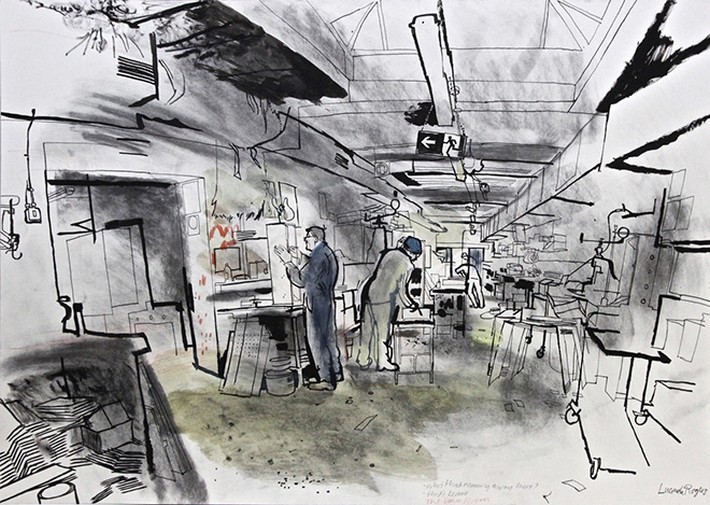
Lucinda Rogers will show a series of large works on paper that depict the workspaces, yards and skills of industrial manufacturing businesses and trades in Tottenham. The drawings will highlight the types of business that are directly threatened by Haringey Council’s plans to promote high-volume housing development in places where people work, which it describes as “restructuring the borough’s employment land portfolio”. The plans will put many active businesses at risk, jeopardising diversity and local jobs. Lucinda Rogers draws directly from life in ink, crayon and watercolour and often portrays working environments and parts of cities that are seldom seen. Along with others including Cass Cities and the Just Space network she is involved in combating the pervasive, short-sighted approach to regeneration that sees London consuming its own assets in pursuit of housing unit numbers. Engineers Heyne Tillett Steel will host the exhibition at their new premises in Clerkenwell.
6. Culture Shapes the Space: Work is always in Progress
China Design Centre
1—18 June
10am—6pm Weekdays
11am—5pm Saturday
China Design Centre, The Building Centre, 26 Store Street, WC1E 7BT
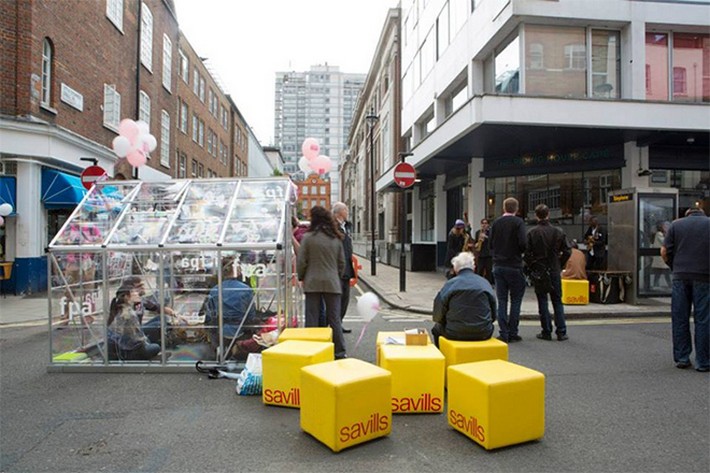
China Design Centre presents six Chinese award-winning interior designers The first-ever showcase of Chinese interior designers based in China. China Design Centre will host an extraordinary workshop where some of these Andrew Martin International Design China award winners will discuss how their culture has shaped their vision, with UK architects and interior designers.
7. Urban Alchemy
Hilary Powell
23—27 June
UCL, see London Architecture Diary for details
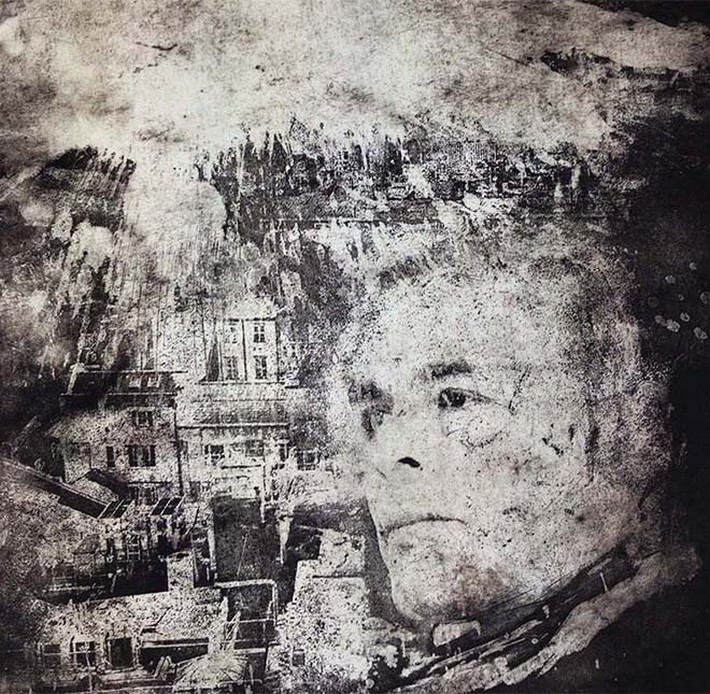
Through imaginative salvage and experiments in chemical printmaking the project Urban Alchemy explores the material stories and processes of urban transformation. My Leverhulme artist residency in UCL Chemistry has allowed for a year of experimentation with and salvage of demolition site materials in a project where creative production and the poetry and politics of place combine with the science, agency and political ecology of materials.
The book itself is a 40 page hard cover cloth-bound gilt edged volume in the traditional of an alchemical ‘book of secrets’ exposing the narratives and techniques of the transformation of these materials over this year of experimentation and exchange. It examines a core ‘family’ of demolition site materials –zinc, copper, slate, brick, stone/concrete, steel, aluminium and asbestos through photographs from the demolition site, of the materials undergoing transformation in chemistry laboratory and print studio and of the image outcomes of these creative and chemical changes. This imagery sits alongside a series of poetic narratives of each of these materials.
8. Reinterpreting the Primitive Hut
The Cass Faculty of Art, Architecture and Design & Sir John Soane’s Museum
2 June—5 July
10am—5pm
Closed Sundays, Mondays and Bank Holidays
Sir John Soane’s Museum, 13 Lincoln’s Inn Fields, WC2A 3BP
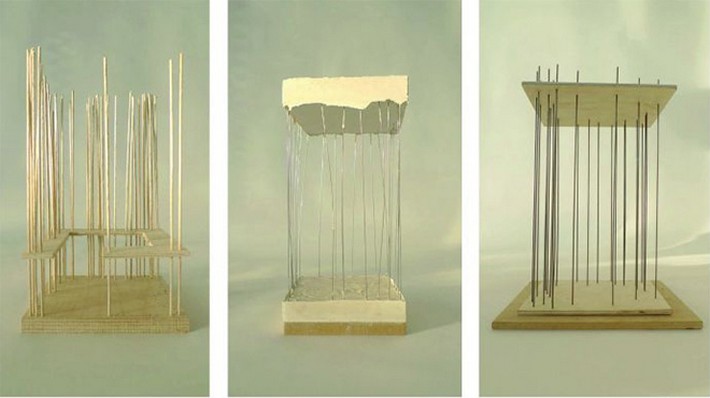
Sir John Soane’s Museum has invited students from seven architectural units at The Cass to respond to the theme of the Primitive Hut using Soane’s own research and materials, and then develop an installation that will sit outside the Museum throughout June as part of the London Festival of Architecture.The students and tutors from each unit – the latter of which includes Florian Beigel, Philip Christou, Stephen Taylor, Pierre D’Avoine and the Free Unit led by Robert Mull – were given unique access to Soane’s extensive collection on the subject, including drawings, books and models that he used to teach his own architecture students.
9. Architecture Open
RIBA London
5—28 June
POP Brixton, 31 Brixton Station Road, SW9 8PB
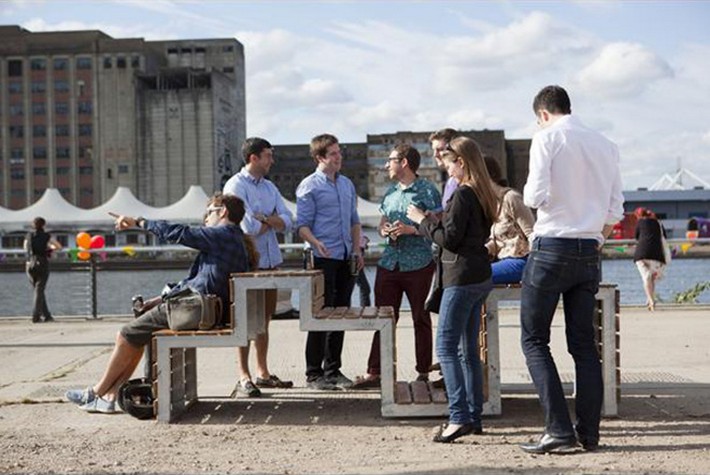
RIBA London’s showcase of member’s works explores the innovation and creative processes contributing our built environment. This year’s exhibition contains works from large Architectural practices such as Stirling prize winners Stanton Williams, to emerging practices like vPPR, to the exciting works being produced by students. The exhibition runs throughout the London Festival of Architecture from the 6th of June to the 28th of June in one of the containers in Pop Brixton.
Join us for the private view on the 5th of June from 6pm. From 7pm a selection of the practices involved will give a brief talk about their pieces and the importance of innovation in architecture today. Carl Turner, founder of Pop Brixton, will discuss the innovative ways which have led to his creation of the exciting community space.
10. Phase/Dynamics
Scott Brownrigg
6—13 June
10am—8pm
Scott Brownrigg, 77 Endell Street, WC2H 9DZ

As part of the London Festival of Architecture 2015, international design practice Scott Brownrigg is holding a free public exhibition entitled “Phase/Dynamics” in the Gallery Space of its Endell Street office.
The exhibition is an expression of accumulation and synthesis in the design process focuses on the transcendental dimension of architecture. It aims to educate and highlight the direct, clear and subtle collective outputs of each RIBA Work Stage.
The exhibition launches with a free interactive workshop on Saturday 6 June which allows members of the public, design professionals and architectural students to consider the purpose of architecture and design as a way to encrypt ideals, to which people can relate to with their own creativity and visionary thoughts.
Through engaging such a timely and provocative topic, we want to provide visitors with the opportunity to explore their own creativity together with building a better understanding of the architectural educational model and the contemporary architectural process of professional immersion.
11. Summer Exhibition 2015
Royal Academy of Arts
8 June—16 August
10am—6pm
Royal Academy of Arts, Burlington House, Piccadilly, W1J 0BD

Get ready to discover your new favourite artist as we head into a summer of colour at the RA. From painting to installation art, you’ll find it all at the Summer Exhibition.
“The Summer Exhibition has never looked so impressive” – The Times
For 247 years, the Royal Academy Summer Exhibition has offered a snapshot of contemporary art – and this year’s exhibition is a riot of colour, variety and discovery with over 1,100 works spilling out from our galleries.
In the courtyard, visitors are confronted by a towering formation of steel ‘clouds’, created by Royal Academician Conrad Shawcross, before Jim Lambie’s kaleidoscopic stairs lead up to the Main Galleries.
12. The Brutalist Playground
RIBA
10 June—14 August
10am—5pm
RIBA, 66 Portland Place, W1B 1AD
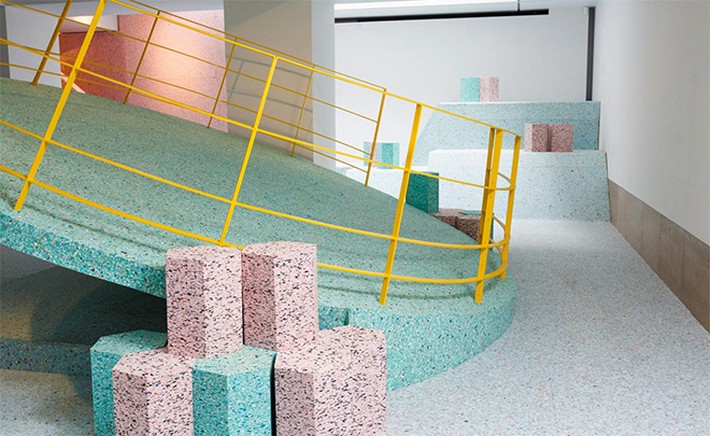
Part sculpture, part architectural installation, all play.
The Brutalist Playground is a new commission by Turner Prize nominees
Assemble and artist Simon Terrill, exploring post-war design for play.
Occupying the entire Architecture Gallery at RIBA, it encourages visitors to look at the materiality and visual language of now lost Brutalist landscapes in new ways through an immersive and conceptual landscape. Although the value of Brutalist residential buildings today is much debated, this exhibition shifts the focus to the equally important playgrounds found at the feet of these structures, offering a renewed understanding and critique of the architects’ original designs and intentions.
13. The Bastions, the Portico and the Farm—Fortified Villas of Northern Italy
Sciaurate Maniere & University of Westminster
11 June—3 July
see London Architecture Diary for details
Marylebone Campus, 35 Marylebone Road, NW1 5LS
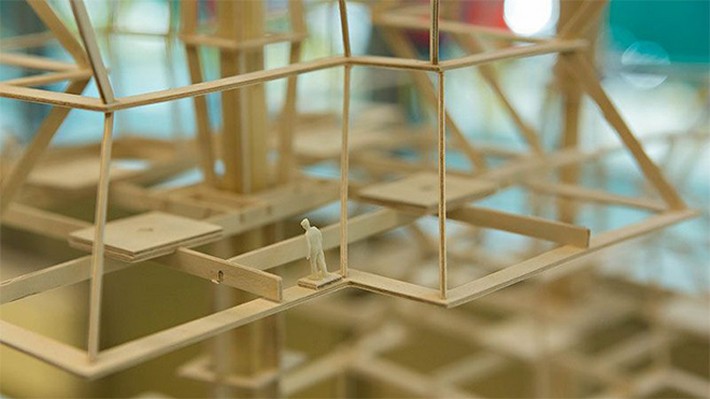
8 beautifully crafted wooden models at 1/33, of the architecture of the Italian Renaissance (suburban pseudo-fortified villas inNorthern Italy). They are displayed with the original manuscript of Serlio’s 6th Book, along with renderings and animations of the villas by Big Rock Studios, Treviso.
14. MADS (Materiality, Architecture & Design + Science)
Jestico + Whiles
15—19 June
10am—6pm
Jestico + Whiles Gallery, 1 Cobourg Street, NW1 2HP
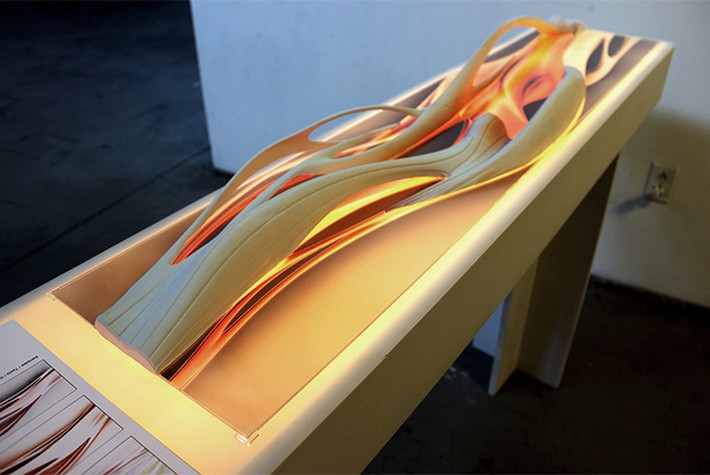
Jestico + Whiles, an architectural firm based in London, has just completed the National Graphene Institute, a research centre at the University of Manchester dedicated to the study of graphene and its commercial applications.
The world’s first 2D material, graphene has broad potential applications across medicine, technology and, in the field of the built environment, it could transform the existing materials we use.
Currently a ‘work in progress’, graphene composites could one day be the material of choice with which to construct buildings, given its multiplicity of properties.
Along with a collection of images retracing the design process of the newly opened building, the exhibition will present design proposals exploring aesthetic and technical possibilities offered by the uses of graphene in the built environment.
The pieces exhibited will be created by a team of architects and designers as a reflection on the themes of materiality, architectural design and science. There will also be an exploration of patterns generated in various fields of science used as inspiration in the built environment.
With Graphene Week also taking place mid-June, the exhibition will stimulate discussion and debate amongst designers, industry and the public about the application of existing and emerging technologies.
15. Organic Grid+—Vision of the Workplace of the Future
Cassidy + Wilson
15—26 June
9am—5.30pm
Domus Tiles Showroom, 50—52 Great Sutton Street, EC1V 0DF

Take a look into the Workplace of the Future with Organic Grid+. The international awarding winning entry to Metropolis Magazine Workplace of the Future 2.0 competition by Cassidy + Wilson, gives a unique insight into what our working lives could be like in 2050. The Organic Grid+ sets out to create a conceptual blueprint for the future of the workplace and pushes the boundaries of the way we see our working environment and ask the question “What If?”The exhibition in a fun and informative experience letting users interact with the exhibit and gives people the chance to experience first-hand how technology and nature, often two opposing forces, can be brought together to create exciting opportunities for the future..Imagine a workplace where employees can harvest their own lunch, digitally customise their surroundings and hold meetings in a field 200ft above the ground! All this is possible via the Organic Grid+. Please be sure to bring smart phones and tablets to get the best experience.


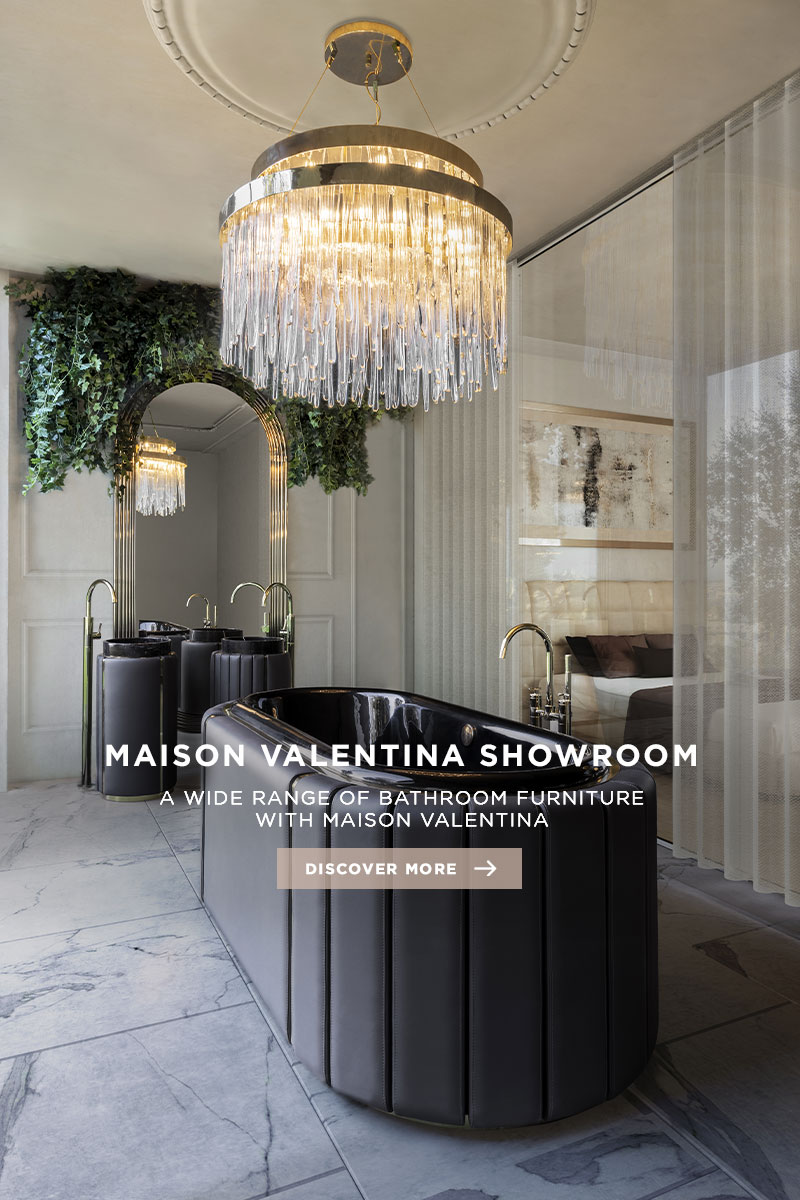
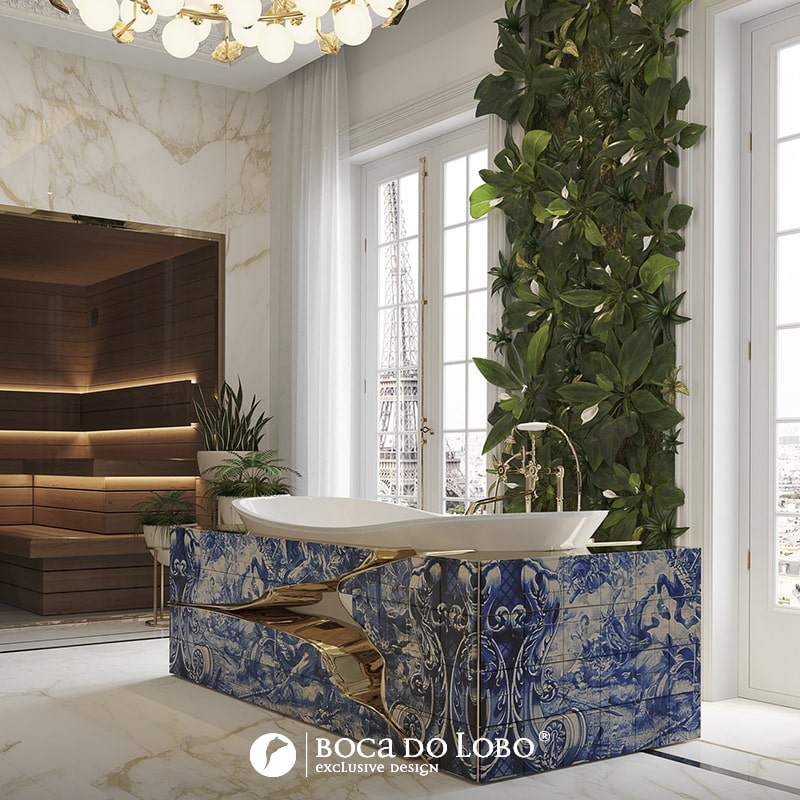
Maison Valentina is all about luxury bathroom company with
a unique design for a luxurious bathroom interior.






1 REGAL HOUSE LENSBURY AVENUE
FULHAM LONDON SW6 2GZ - LONDON
EMAIL: UK@COVETLOUNGE.NET
PHONE: 0203 592 6789